Making Evaluation Stick: Build Habits, Not Checklists
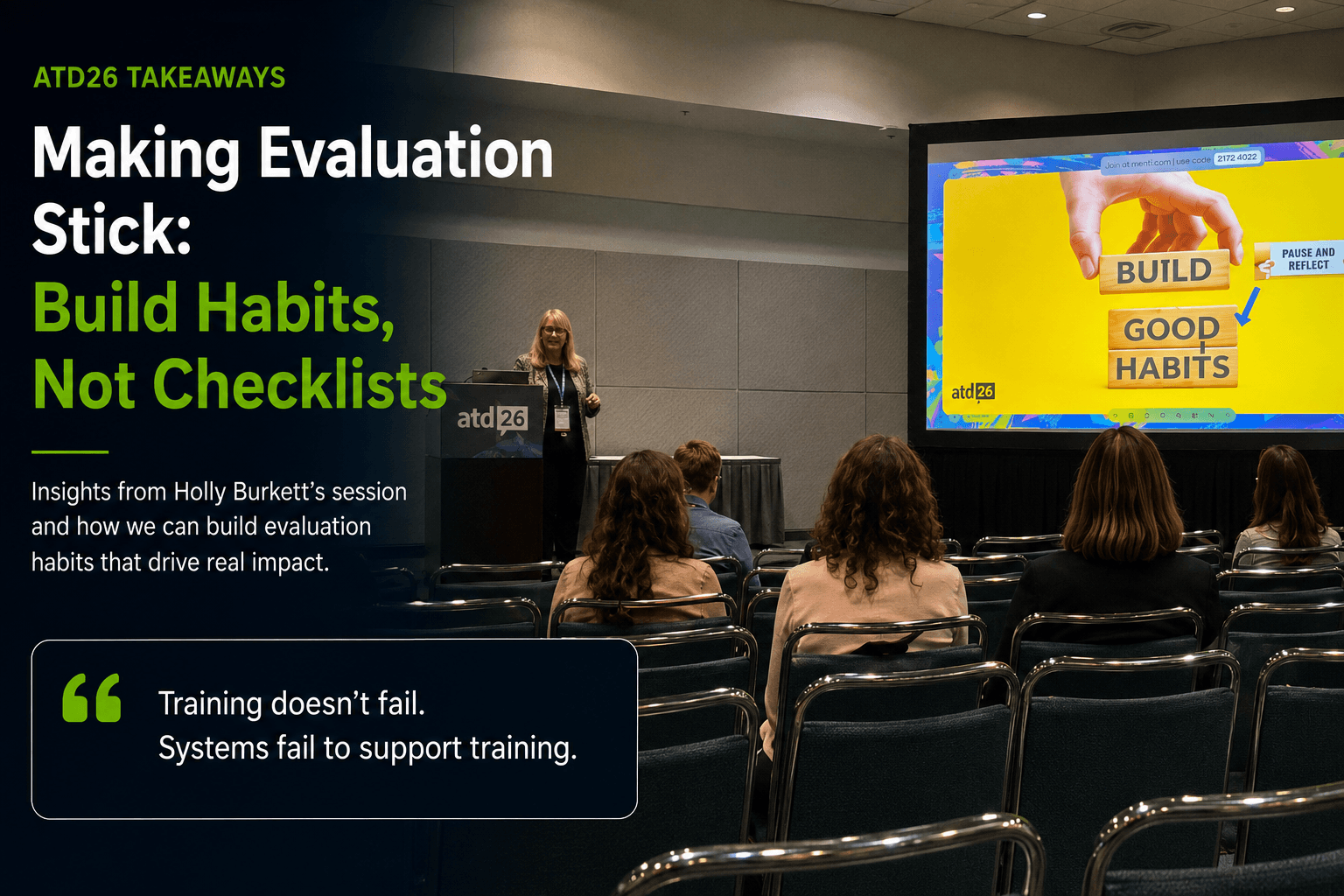
At ATD26, I attended Holly Burkett's session, "Making Evaluation Stick: Build Habits, Not Checklists," and it named a tension many L&D teams feel every day.
We know evaluation matters. We know data matters. We know leaders want evidence that learning is creating business value. But somewhere between the survey, the dashboard, and the follow-up meeting, evaluation can become a compliance routine instead of a performance practice.
Evaluation does not stick because we build better forms. It sticks because we build better habits.
Before, During, and After
One of the strongest ideas from the session was simple and practical: if evaluation only shows up at the end, we are already late. The important signals begin before learning starts, continue during the experience, and become most visible in application after learning.
Before learning, are we aligned on the business problem and expected behaviors? During learning, are we seeing evidence of skill growth and relevance? After learning, are managers removing barriers so people can actually apply what they learned?
Systems, Not Just Sessions
"Training does not fail. Systems fail to support training."
That line landed for me because it reframes the conversation. Great facilitation, thoughtful design, and polished content still struggle in environments with no time, no coaching, no accountability, and no alignment.
Learning transfer is where value is either created or lost. The better question is not just, "Did they like the training?" It is, "What is helping or preventing people from using it?"
Data With Relationships
Data builds credibility. Relationships make the data actionable.
The session also reinforced a practical truth: strong evaluation is not only a technical skill. It is also a relational one. We need business partners to define useful measures, managers to reinforce behavior change, and learners to tell us what is actually happening on the job.
In my own work, I have used Python automation to run 90-day follow-ups and feed results into a dashboard. That has improved consistency. But this session pushed me to think beyond automation toward better evidence and sharper questions tied to outcomes.
The Shift
A checklist says, "Send the survey." A habit asks, "What did we learn, and what are we changing because of it?"
For me, that is the takeaway from Holly's session. Evaluation is not a closing task. It is an operating rhythm. When it becomes a shared habit across sponsors, managers, facilitators, and learners, learning impact becomes visible, supported, and continuously improved.