You Cannot Outsource Perspective
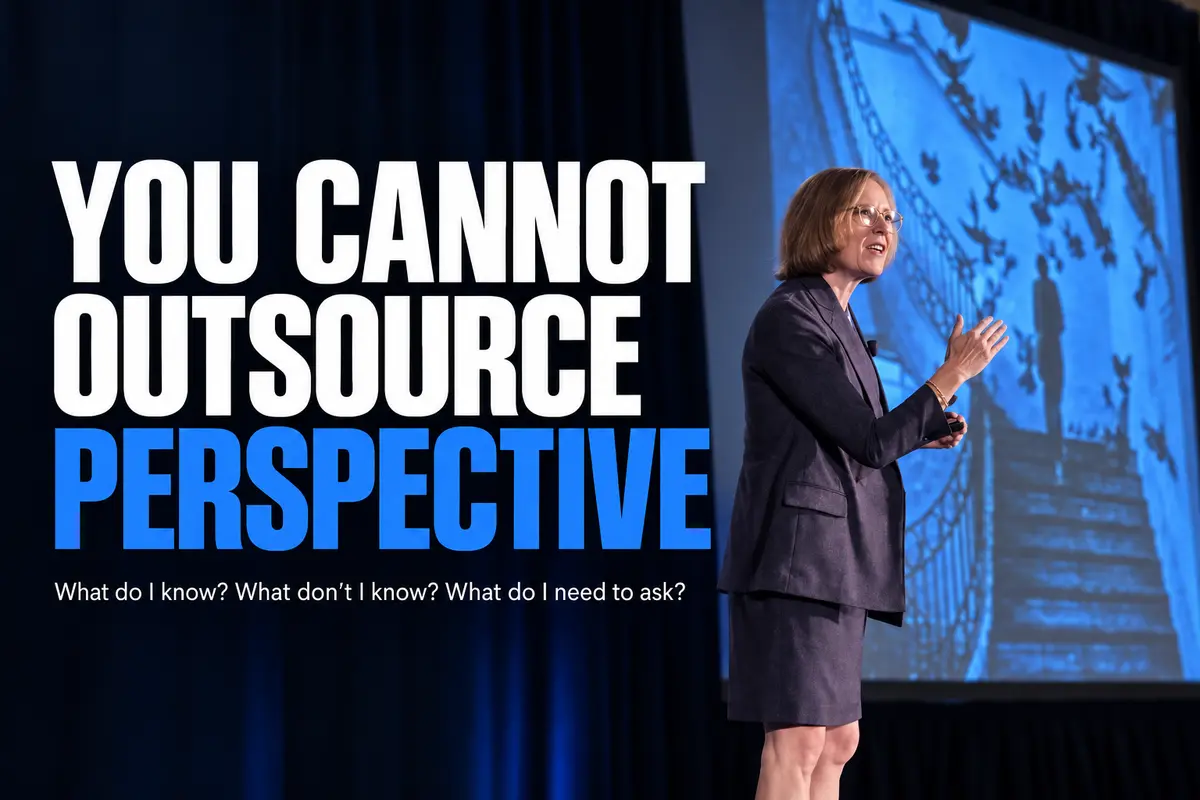
Amy Herman put a blurry abstract painting by Hedda Sterne on the screen at TechLearn 2026 and told us it was never going to come into focus.
That was the point.
Most of us work like clarity is one more tool away. A better dashboard. A cleaner summary. A smarter model. But adding information to a noisy problem usually gives us a noisier problem. Someone still has to decide what matters, what is missing, and what another person needs to know.
Amy is an art historian and the author of Visual Intelligence. She spent the keynote showing us paintings and photographs, then asking us to describe what we saw. I expected a session about observation. I left thinking about judgment, communication, and all the quiet assumptions we make when we design learning.
The session stayed practical from start to finish. Every painting became a tool I could use in a meeting, a design review, or the next conversation where two people swear they are looking at the same problem.
She told us we did not need to take notes. I broke that rule for one sentence.
“You cannot outsource your perspective.”
Stop Calling It Obvious
Amy gave the room a rule for the rest of the conference: stop using the words obviously and clearly. Nothing is obvious, and even less is clear.
I felt that one immediately. In learning, “obvious” is often where our assumptions hide. The next step feels obvious because we already know the process. The acronym feels clear because we use it every day. Then a learner gets stuck and we act surprised.
No one is inside our head. We have to lay the groundwork out loud. What are we looking at? Why does it matter? What needs to happen next? That context is not extra. It is what lets people use the rest of the information.
The Blue Glove Was Good Design
Amy told a story about racing to make a tight airport connection. A flight attendant handed blue latex gloves to every passenger with less than 30 minutes to connect. When the plane landed, anyone wearing a glove exited first.
It was simple, visible, and built from something already on the plane. No new system. No long explanation. The important signal was impossible to miss.
We sometimes overdesign a problem because we are excited about the tool. The better question is: what simple signal would make the right action easier?
I catch myself wanting to start with a product, a course, or a platform. Sometimes the answer is already in the room. We just have to look at the resources differently.
Five Seconds Changed the Answer
For one exercise, we worked in pairs. One person closed their eyes while the other had 45 seconds to describe a work of art. In the second round, the person describing the image had to stay quiet for the first five seconds and collect their thoughts.
Five seconds felt like a lot when the clock was running. It also made the descriptions better. That pause gave people time to find the big picture, choose the useful details, and decide what their partner needed first.
We do the opposite at work all the time. We walk out of a meeting and forward a pile of notes. We send a transcript when someone asked for the takeaway. We give people everything because we did not stop long enough to decide what matters.
A useful update should tell me where we are, what changed, what remains unresolved, and what you need from me. More information is not the same thing as better communication.
The Three Questions I Will Actually Use
Amy shared a simple method for working through information before jumping to a conclusion:
- What do I definitively know?
- What do I not know?
- If I could get more information, what would I need to ask?
She applied those questions to a photograph of a man standing in monsoon water with a sewing machine. Without context, we could describe the scene and make guesses. The fuller story was that he was a tailor who had lost nearly everything but managed to save the tool that let him make a living.
That framework might be the best prompt advice I heard at a learning technology conference, even though Amy did not present it that way. A model can help organize an answer, but the quality of the work still depends on whether we separated what we know from what we assumed.
Perception Is Not Perspective
Amy made a distinction I keep coming back to. Perception is the information we take in. Perspective is what happens when we pause and process that information through context, assumptions, and experience.
Technology can expand what we can collect, compare, and summarize. It cannot bring every lived experience into the room by itself. That is why other people still matter. Someone else will notice the detail I skipped, question the assumption I did not realize I made, or understand a context I have never lived.
This was the part that connected most directly to my work. Good design gets stronger when more than one perspective shapes it. A learner sees friction the designer misses. A manager sees constraints the learner may not. The person doing the job sees whether the solution has any chance of surviving contact with a real workday.
I can build the cleanest learning experience in the world. If I never ask the learner, the manager, or the person doing the job what they see, I have built it from one angle and called it complete.
What I Am Taking Back
- Say the foundation out loud, even when it feels obvious to me.
- Separate what I observe from what I assume.
- Ask what is missing before I ask a tool to solve the problem.
- Bring in people who see the work from a different angle.
- Pause long enough to turn information into something another person can use.
At a conference built around learning technology, one of the most useful reminders came from looking at art. More capability does not remove the need to pay attention. It raises the standard for how well we do it.
Amy's keynote worked because I left with things I can actually use: a visible signal instead of a complicated system, three questions before jumping to answers, and a reminder to invite more perspectives before calling a design finished.
The noise is not going away. We have to get better at deciding what deserves our attention, saying what we see, and listening when someone else sees something we missed. That human perspective is the part worth protecting.