The Expert Bottleneck
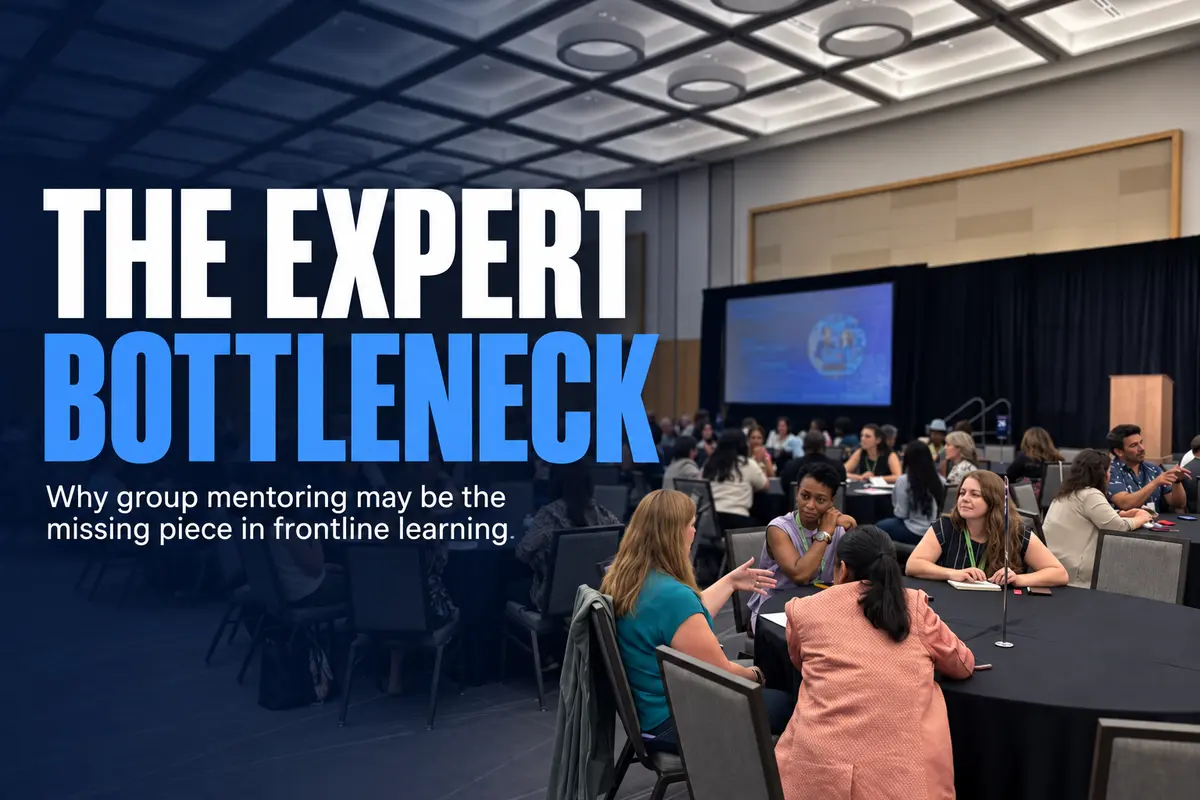
I sat at table 13 because my daughter is a Taylor Swift fan.
That was about as much planning as I put into where I sat. Some people had registered for the Braindate. Others appeared to have found the table by accident. Someone was still fighting with the conference app. Nobody seemed completely sure when we had officially started.
Then the conversation took off.
At TechLearn 2026, Manny Martinez, MBA, Senior Client Partner at MentorCliQ, led a Braindate about mentoring frontline workers.
This was not a presentation. There were no slides and no polished framework waiting for us. It was a practical peer exchange between people working in veterinary medicine, manufacturing, utilities, government, technology, and learning and development.
The industries were different, but the problem was remarkably consistent.
There are too few experts to train everyone.
The Problem Is Not a Lack of Content
Learning teams have spent years improving content.
We have shorter modules, mobile learning, videos, searchable resources, kiosks, job aids, and learning management systems. Those tools can make information easier to access.
But access to information is not the same as access to expertise.
One person at the table worked in a specialty veterinary hospital. Her team cannot schedule the arrival of a specific medical emergency just because someone needs practice. A procedure might happen five times in one week and then not happen again for a month.
She can prepare someone with a model. She can introduce the instruments. She can walk through the steps.
Eventually, though, the learner has to perform in a real situation with an experienced person nearby.
Another participant supported employees in a manufacturing environment. She had introduced an LMS and placed learning kiosks throughout the shop. The technology existed. The harder challenge was getting people away from production long enough to use it.
The employees responsible for mentoring were also responsible for producing.
That tension showed up throughout the conversation. The people with the most knowledge are often the people with the least time to share it.
One-to-One Mentoring Does Not Scale Easily
We usually picture mentoring as a relationship between two people.
One person has experience. The other person wants to learn. They meet regularly, talk through challenges, and build trust over time.
That model can be powerful. It is also mathematically unforgiving.
If an organization has hundreds or thousands of frontline employees and only a small number of experienced people, one-to-one mentoring quickly creates another workload problem. The same experts are asked to perform the work, meet production goals, solve problems, answer questions, and develop everyone around them.
Eventually, the system depends on a few generous people continuing to take on more.
That is not a mentoring strategy. It is an expert bottleneck.
Group Mentoring Changes the Math
The idea that stayed with me most was group mentoring.
Instead of assigning every learner an individual mentor, one experienced person can work with a small group. The group might meet after completing formal training, during a scheduled development session, or around a specific skill or problem.
The expert does not have to repeat the same conversation six different times. Learners also benefit from hearing questions they may not have thought to ask.
One person brings a difficult scenario. Another notices a connection. Someone else explains how the process looks in a different role.
The expertise still matters, but it is no longer trapped inside one relationship.
This does not replace hands-on practice or individual feedback. Some skills still require direct observation and coaching. Group mentoring creates a bridge between consuming information and applying it.
It gives people a place to ask, “What does this look like when the situation is not as clean as the training?”
That is often where the real learning starts.
Expertise Does Not Automatically Make Someone a Mentor
The conversation also raised an uncomfortable question.
What happens when the expert is not good at teaching?
Organizations often select mentors because they have been there the longest or perform the work well. Neither guarantees that they can explain their decisions, provide useful feedback, or create space for someone else to learn.
If group mentoring is going to scale expertise, the mentors need support too.
They need clear expectations, useful prompts, boundaries, and some preparation for facilitating a group. Otherwise, we risk scaling inconsistent advice or bad habits along with the expertise.
The goal is not to turn every experienced employee into a professional trainer. It is to give them enough structure to share what they know without forcing them to invent the process themselves.
Learning Time Has to Count as Work
Organizations like to describe professional development as a benefit.
That sounds good until employees are expected to complete it after a shift, during a break, or in whatever spare time production leaves behind.
If learning only happens when the work slows down, it will rarely happen.
Manny shared examples of organizations protecting time within a shift or paying employees for time spent in mentoring sessions. The exact approach will depend on the workplace, but the principle should remain the same.
If development matters to the organization, time for development has to count as work.
That requires more than executive approval. Frontline supervisors and middle managers have enormous influence over whether employees can participate. They are balancing schedules, staffing, output, safety, and performance.
Telling them that learning is important does not remove any of those pressures.
They need to understand the value, see the expectations, and have enough flexibility to make participation possible.
Measure Progress Without Pretending Confidence Is Competence
The group also discussed measuring how people feel before and after a mentoring experience.
A short survey can show whether someone feels more prepared, supported, or confident. That information can be useful, especially when leaders need evidence that an initiative is worth continuing.
Confidence alone does not prove that someone can perform a skill.
For frontline development, measurement should eventually reach the work itself. Can the employee complete the task? Can they respond when the situation changes? Can they explain why they made a decision?
A strong mentoring program can combine both sides. Ask people how prepared they feel, then give them opportunities to demonstrate what they can do.
The Braindate Demonstrated Its Own Point
The conversation itself became an example of why group mentoring works.
Manny brought years of experience with mentoring programs and technology. One participant brought the unpredictability of emergency veterinary medicine. Another brought the production pressures of a manufacturing floor. Others asked questions about measurement, manager support, skill progression, and access.
No single person had the complete answer.
The value came from putting those perspectives at the same table.
I did not leave with a perfect five-step model for frontline mentoring. I left with a better way to frame the problem.
Frontline learning is not simply a content problem. It is an access problem.
People need access to time, access to experienced colleagues, and access to conversations where information can become judgment.
When expertise stays locked inside one-to-one relationships, it will always be scarce.
Group mentoring gives that expertise somewhere to travel.